

|

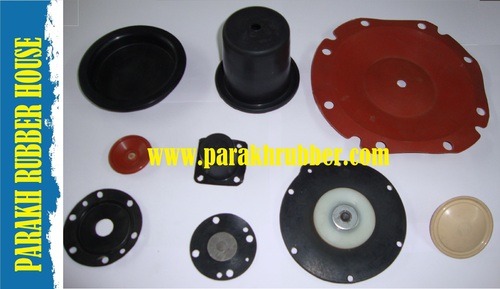
Rubber Diaphragms
50.00 - 500.00 INR/Piece
Product Details:
- Usage & Applications Industrial
- Feature Light Weight
- Water Absorption No
- Diameter 2 to 4 mm Millimeter (mm)
- Material Rubber
- Thickness 4-15 Micrometers (um)
- Natural Rubber Yes
- Click to View more
X
Rubber Diaphragms Price And Quantity
- 50.00 - 500.00 INR/Piece
- 50 Piece
Rubber Diaphragms Product Specifications
- 4-15 Micrometers (um)
- Yes
- Rubber
- 2 to 4 mm Millimeter (mm)
- No
- Light Weight
- Industrial
Rubber Diaphragms Trade Information
- 10000 Piece Per Day
- 7 Days
- All India
- ISO 9001:2015
Product Description
Rubber Diaphragms
Offered Rubber Diaphragm is widely suited for different industries and is accessible with different exclusive features. It has a flexible barrier, which is included with moving as well as stationary units/members. The primary function of the Rubber Diaphragm is to prevent fluid interchange between two separated compartments. It allows for a flexible barrier and it has primary function to prevent the fluid interchange between two detached chambers. It has been assembled with rubber sheets. It works as a sensing element and assists in the pressure measurement as well.
Material: VITON, SILICONE, NEOPRENE, POLACTALE, HNBR, NBR, SBR, ECO, HYPALONE, EPDM, POLYURETHANE, BUTYL, ACETAL (POM) ,PU, etc.
Note: We Develop any Polyurethane & Rubber products based on its operating Condition as per given Specifications, Samples or Drawings.
Precision and Durability
Designed from high-quality natural rubber, these diaphragms provide precise thickness and diameter options to meet specific industrial requirements. Their robust construction ensures dependable performance even under challenging operating conditions while their lightweight feature simplifies handling and installation.
Optimized for Industrial Applications
With no water absorption and a lightweight profile, our rubber diaphragms are particularly suited for industries requiring reliable sealing and separation functions. Manufacturers and suppliers throughout India benefit from their adaptability and consistent quality, enhancing machinery efficiency and operational reliability.
FAQs of Rubber Diaphragms:
Q: How are rubber diaphragms manufactured to achieve precise thickness and diameter?
A: Rubber diaphragms are produced using advanced molding and cutting technologies that enable precise control of material thickness (4-15 micrometers) and diameter (2-4 millimeters). This ensures uniformity and accuracy across batches for reliable industrial performance.Q: What makes natural rubber suitable for industrial diaphragms?
A: Natural rubber is preferred for diaphragms due to its excellent elasticity, resilience, and resistance to deformation. These properties are vital for creating flexible seals that maintain integrity in demanding industrial environments, enhancing overall equipment efficiency.Q: When should you consider using rubber diaphragms in your machinery?
A: Rubber diaphragms should be used when you require a dependable, lightweight solution for sealing, isolating, or separating components within industrial machinery. Their specific dimensions and material properties suit a wide range of applications across various industrial sectors.Q: Where are these rubber diaphragms commonly applied?
A: These rubber diaphragms are utilized throughout India in industries such as automotive, chemical processing, pharmaceuticals, and manufacturing. Their role is crucial in devices where tight sealing and fluid or vapor containment are essential.Q: What is the process involved in distributing or sourcing rubber diaphragms in India?
A: To acquire or distribute rubber diaphragms, businesses typically connect with manufacturers, exporters, suppliers, distributors, traders, and wholesalers specializing in industrial rubber products. The process involves specifying required sizes and properties based on the intended application.Q: How do rubber diaphragms benefit industrial operations?
A: Rubber diaphragms enhance industrial operations by providing reliable, leak-proof barriers within machinery, increasing efficiency and reducing maintenance needs. Their lightweight design also facilitates easier installation and replacement, contributing to overall costeffectiveness.Q: What applications are best suited for lightweight rubber diaphragms?
A: Lightweight rubber diaphragms are ideal for applications where responsive movement and minimal pressure resistance are necessary, such as in pumps, valves, and control devices within industrial systems.Tell us about your requirement

Price:
Quantity
Select Unit
- 50
- 100
- 200
- 250
- 500
- 1000+
Additional detail
Mobile number
Email


PARAKH RUBBER HOUSE
GST : 07AEVPC6067Q2ZL
GST : 07AEVPC6067Q2ZL
Contact Details

- NJ-140, Sector - 3, DSIDC, Bawana Industrial Area,Delhi - 110039, India

- Phone :08045815733

- Mr Raman Chopra (Proprietor)
- Mobile : 08045815733


 Send Inquiry
 |
PARAKH RUBBER HOUSE
All Rights Reserved.(Terms of Use) Developed and Managed by Infocom Network Private Limited. |
